The Cosmic Dancer at CERN
On the profound wisdom hidden in plain sight, where the universe's deepest physics meets its most ancient myth.

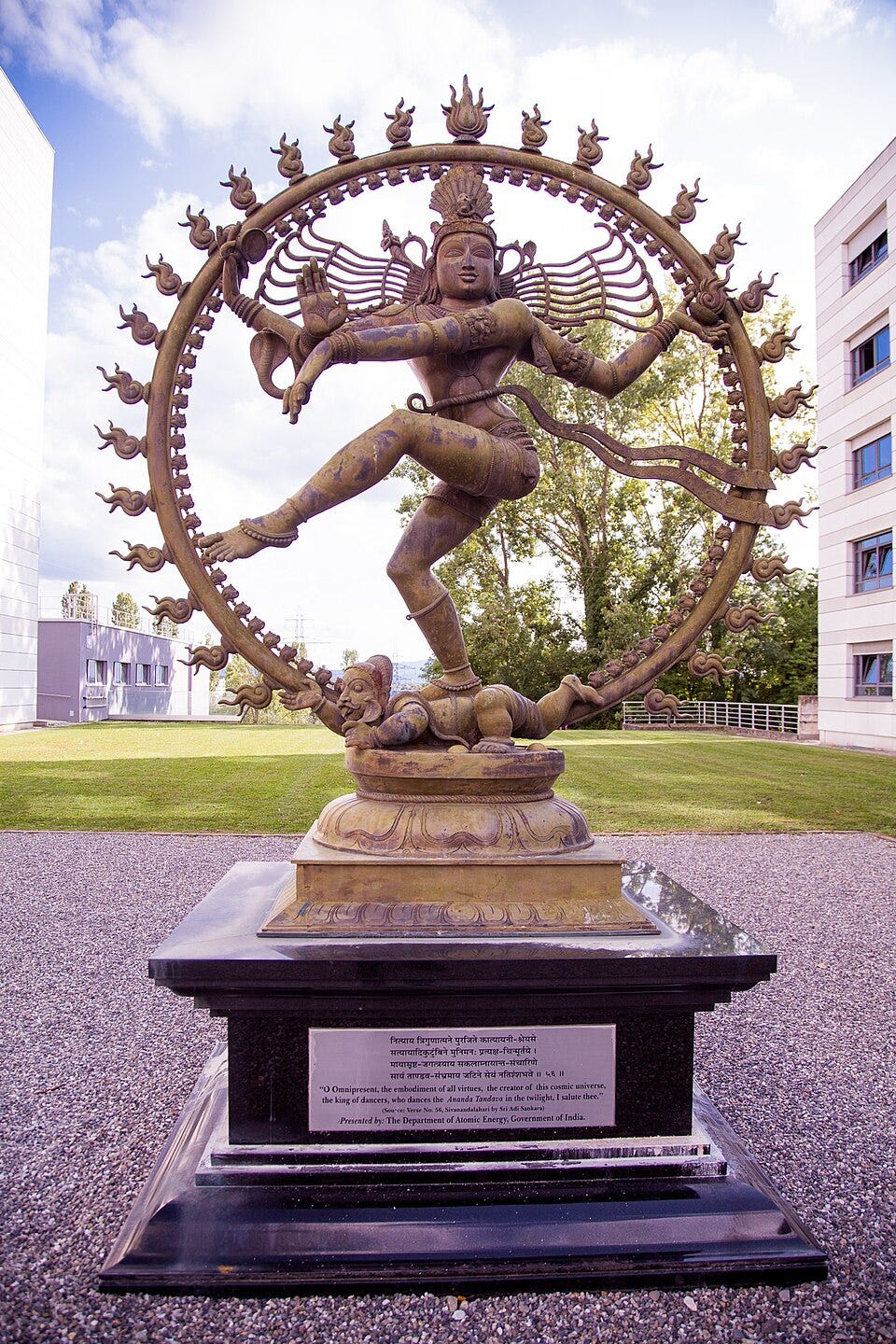
At the entrance of CERN — the European Organization for Nuclear Research in Geneva, Switzerland, home to the largest and most powerful particle accelerator ever built by human hands, stands a bronze statue unlike anything you might expect to find outside a laboratory dedicated to the deepest questions of matter, energy, and the fabric of existence.
It is the dancing figure of Shiva.
For many who encounter this image for the first time, it provokes unease. The name “Shiva” echoes in the popular imagination as the Lord of Destruction — a deity of endings, of annihilation, of cosmic dissolution. And so the questions arise, sometimes as whispers and sometimes as accusations: Is CERN a force of destruction? Are the scientists playing with forces they should not touch? Is there something sinister encoded in this choice?
These questions deserve a serious answer. But to find that answer, one must look more carefully, much more carefully, at precisely what this statue represents, and why its presence at the threshold of humanity’s most ambitious scientific project is not a warning of doom, but one of the most sophisticated philosophical statements in modern institutional history.
I. This Is Not the Shiva You Think You Know
The statue at CERN does not depict Shiva in his fearsome aspect as destroyer. It depicts him in the form known as Nataraja — a Sanskrit word meaning precisely Lord of Dance. In this form, Shiva is shown in a posture of exquisite balance and grace: one leg raised, arms extended, surrounded by a ring of flame, his face serene and radiant with a calm, knowing smile.
This distinction matters enormously.
In the iconographic language of Hindu cosmology, Nataraja represents something far more nuanced than destruction. The dance he performs is the Ananda Tandava, the Dance of Bliss, understood by the great sages as the cosmic rhythm that underlies all existence: the ceaseless pulse of creation and dissolution, of particles arising from the quantum field and returning to it, of stars born from gas clouds and collapsing back into them.
The universe, in this vision, is not a machine. It is a dance.
It is no accident that CERN chose this particular image. Fritjof Capra, the physicist and author of The Tao of Physics, spent years documenting the remarkable parallels between the dance of Nataraja and the behavior of subatomic particles, the endless creation and annihilation of matter in the quantum world that modern physics has revealed. A plaque beside the statue quotes him directly:
“Modern physics has shown that the rhythm of creation and destruction is not only manifest in the turn of the seasons and in the birth and death of all living creatures, but is also the very essence of inorganic matter. For the modern physicists, then, Shiva’s dance is the dance of subatomic matter.”
— Fritjof Capra, The Tao of Physics
When you look at CERN’s mission, to understand the fundamental nature of matter, to trace the behavior of particles at energies approaching those of the Big Bang, you begin to see why a cosmic dancer who embodies the rhythm of existence is an entirely fitting symbol.
II. The Hidden Figure: What Almost Nobody Notices
Now we arrive at what is perhaps the most astonishing dimension of this sculpture, a detail so small, so easy to miss, that most who photograph the statue never notice it at all.
Look closely beneath Nataraja’s raised foot, upon which the dancing god lightly but firmly presses.
There, half-crushed into the earth, lies a figure.
This is Apasmara — and understanding Apasmara may be the most important thing a scientist, or indeed any human being who has ever held knowledge with pride, can do.
The Birth of Apasmara
In the ancient forests of India, there lived a community of sages of immense wisdom and learning. But over time, something subtle and deadly crept into their hearts.
Their rituals, once performed in genuine devotion, slowly became performances of pride. Their knowledge, once held in service of truth, curdled into arrogance.
And from the heat of their corrupted fires, from the smoke of their ego-stained ceremonies, there was born a creature: half-human, half-shadow, deformed and wretched.
This was Apasmara, the Dwarf of Ignorance. Not ordinary ignorance, the ignorance of those who have forgotten that they do not know everything. The ignorance that is born not from a lack of knowledge, but from an excess of pride in the knowledge one already has.
The sages who created Apasmara could not control him. Once born, he ran amok, clouding the minds of even the wisest, making the learned forget their wisdom, causing the spiritually advanced to stumble and fall. He was the force that turns a scientist into an ideologue, a sage into a tyrant, a healer into a monster. He was the shadow-self of knowledge itself.
And so Shiva appeared.
Not as a warrior with weapons drawn. Not as a god of wrath come to smite the wicked.
He appeared as Nataraja — the Dancer — with a gentle smile on his face and a flame of cosmic awareness in his palm. He raised one foot… and placed it, with divine precision and infinite calm, upon Apasmara’s back.
Not killing him. Not destroying him.
Restraining him.
This is why Apasmara lies beneath Nataraja’s foot in every temple and every casting of this sculpture. It is a reminder written in bronze: to grow, one must continuously, consciously hold ignorance down, before it rises again.
Apasmara cannot be destroyed — for if ignorance were entirely annihilated, there would be nothing left to overcome, no wisdom left to exercise, no humility left to practice. The effort itself would cease to exist. And so Shiva does not kill the dwarf. He holds him down, forever.
III. Why This Symbol Belongs at the World’s Greatest Laboratory
Consider now what CERN represents.
It is perhaps the most concentrated gathering of human intellectual genius in history, thousands of physicists, engineers, mathematicians, and researchers from over one hundred nations, collaborating to probe the most fundamental questions the human mind has ever dared to ask. Here, particles are accelerated to within a fraction of the speed of light. Here, the Higgs boson was discovered, completing the Standard Model of particle physics. Here, the World Wide Web was born.
The knowledge held within CERN’s corridors is staggering in its depth and power. And it is precisely because of this, because of the immensity of the knowledge gathered in that place, that the figure of Nataraja standing with his foot upon Apasmara is not decoration.
It is a living philosophical statement of radical self-awareness.
Oppenheimer’s Warning
On July 16, 1945, as the first nuclear weapon detonated in the New Mexico desert, J. Robert Oppenheimer — director of the Manhattan Project, one of the most brilliant physicists of the twentieth century, recalled a verse from the Bhagavad Gita, the same Hindu sacred text from which the Nataraja tradition flows.
His words have echoed through history ever since:
“Now I am become Death, the destroyer of worlds.”
Here was a man of supreme scientific achievement, confronted in the moment of his greatest triumph with the terrifying awareness of what knowledge unchained from wisdom could do.
Apasmara had risen.
And there was no Nataraja in the room to press him down.
This is why the statue matters. It is an institutional act of humility, an acknowledgment built into the very architecture of humanity’s most powerful scientific institution that knowledge without wisdom is dangerous; that the more we learn, the more vigilant we must be against the arrogance that learning can breed; that Apasmara is always waiting, always watching, always ready to whisper to the brilliant mind that it already knows enough.
IV. The Deeper Convergence: Science and Spirit
There is a quote widely attributed to Louis Pasteur — the French chemist and microbiologist who gave humanity vaccines against rabies and anthrax, who revolutionized medicine and saved countless millions of lives, that speaks directly to this mystery:
“A little science distances you from God, but a lot of science brings you nearer to Him.”
This paradox is one of the most profound truths in the history of human thought.
The scientist who has only scratched the surface of knowledge often believes, with Apasmara whispering in his ear, that he has understood the machinery of the universe and has no need for the language of transcendence.
But the scientist who has gone deep, who has sat with quantum mechanics and contemplated the mystery of why anything exists at all, who has traced the arrow of time back to a singularity of infinite density, who has looked at the mathematical structure of reality and found it unutterably beautiful, tends to arrive, through a very different path, at the same humility and wonder that the mystic cultivates through prayer and silence.
At the deepest level, the language of science and the language of spirit are both pointing at something they cannot quite reach.
The physicist speaks of the quantum vacuum, not empty, but seething with potential, from which particles spring into existence and dissolve back into nothingness in a ceaseless cosmic dance.
The Hindu sage speaks of Brahman, the ground of being, not a thing but the source of all things, from which all of manifest reality arises and into which it dissolves in the rhythm of Nataraja’s eternal dance.
These are not the same description. But they are not unrelated ones.
The more powerful our instruments, the more carefully we must be with what we do with their findings. The smarter we become, the more deliberately we must press our foot upon the dwarf of arrogance that our intelligence itself generates.
The statue of Nataraja at CERN is not a spiritual intrusion into science. It is the most perfectly chosen emblem imaginable for an institution dedicated to not knowing, to asking, always, deeper questions.
A Message to the Scientific Community
Keep studying. Keep questioning. Keep reaching into the darkness with your instruments and your equations.
The more you advance, the more you will find yourself standing at the edge of mystery, not diminished, but enlarged. Not farther from the sacred, but deeper within it.
And as you walk through the world bearing the extraordinary gift of knowledge, remember the dwarf beneath the dancer’s foot.
Press him down gently, daily, with a smile.
For it is not the ignorant who must fear Apasmara most.
It is those who know.
Dance wisely. Dance humbly. The cosmos is watching.
Nakhli Khoury writes at the intersection of science, spirituality, and human consciousness.